Someday, Nepal
I’m someone who can’t go anywhere easily.
Not because I don’t want to. I want to, more than I usually admit. It’s just that I was born into a family like mine: Bangali, middle class, Asian, brown. If you grew up in a house like this, you probably know how it goes. Travel isn’t a hobby, it’s a “later” thing. First you study, then you get a job, then you settle down, and after all that, maybe, you can think about going somewhere.
So wanting to wander alone with a camera, for no reason except to see things, sounds almost like a sin. Wishing for something that isn’t practical, isn’t safe, and costs money your family needs for real things. I’m not blaming anyone. My family wants a safe life for me, and I understand that. But understanding it doesn’t make the wish go away.
So I do the next best thing. I watch other people go.
Watching from the other side of the screen
I watch Nadir, and a lot of other travellers. I watch them reach a mountain, wait for the light, and take one photo that says more than a whole page of writing. They sleep in strange places, walk for days, and come back with pictures of places I’ve only seen through their cameras.
Every time, I think the same thing: I want to do that, at least once.
Why photography
A photo is a way of saying “I was here, and this is what it felt like.” I want to learn to say that properly. How light works, how to wait, how to notice a small moment before it’s gone.
I should be honest: I’m not an expert. I haven’t taken a course. Everything I know about photography comes from watching YouTube videos and falling down rabbit holes late at night. So take this as a beginner’s notes, not a lesson.
What I’ve learned photography actually is
Before I started watching, I thought photography was just “pointing a camera at something nice.” It turns out there are whole worlds inside it:
- Landscape: mountains, rivers, valleys. Mostly patience, and being in the right place at the right time.
- Portrait: people, faces, the story behind someone’s eyes.
- Street: ordinary life, caught at exactly the right second.
- Wildlife: birds and animals, which means waiting for hours and getting one frame.
- Macro: tiny things, like an insect or a drop of water, made huge.
- Travel and documentary: telling the story of a place and its people.
- Long exposure: silky rivers, light trails, anything that moves slowly.
- Astrophotography: the night sky, and the one I want the most.
And under all of them, a few basics that every video repeats:
- Aperture, shutter speed and ISO. Three settings that decide how much light reaches the camera, how motion looks, and how grainy the photo gets.
- Light. Golden hour (just after sunrise, just before sunset) and blue hour (the quiet time after the sun is gone) make almost anything look beautiful.
- Composition. Rule of thirds, leading lines, framing. Ways to make the eye go where you want.
- Editing. Shooting in RAW and fixing light and colour afterwards. A good photo is often made twice, once in the camera and once on the screen.
Why Nepal
If I ever get one chance to travel, I already know where I’d go. Nepal. Alone, slowly, with a camera, and no plan except to learn.
Mountains, rivers, villages, and people who live every day in places the rest of us photograph for a living. I can’t think of a better classroom.
The dream inside the dream
There’s one more thing I want from that trip: astrophotography. I want to stand somewhere high, far from city lights, and photograph the night sky.
From what the videos taught me, it works like this. You put the camera on a sturdy tripod and keep the shutter open for a long time, usually somewhere between 15 and 25 seconds. In that time the camera collects light that your eyes can’t gather, and the Milky Way slowly shows up on the screen. You need a wide lens that lets in a lot of light, a high ISO, and manual focus on a bright star. There’s also something called the “500 rule”: divide 500 by your lens’s focal length and you get roughly how many seconds you can expose before the stars start to look like little lines instead of dots.
The most important part, though, isn’t the camera. It’s the sky. You need darkness: no moon, no city lights, no clouds.
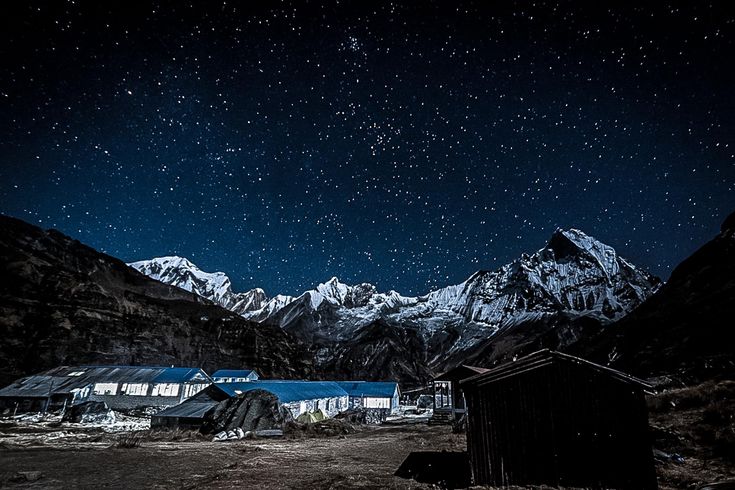
A sample of what I’m dreaming about. This is not my photo. Image from Pinterest, credit to the original photographer.
In a big city like Dhaka, the night sky is mostly washed out by light. The stars are still up there, but you almost can’t see them. In the high mountains it’s a different story. From what I’ve read, the air is thin, there’s very little light pollution, and spring and the weeks right after the monsoon usually give the clearest skies. It’s also very cold, and high altitude is serious business, so it needs real planning, not just courage.
Honestly, I don’t know yet if it’s possible from a mountain in Nepal, or what it would really take. But if it can be done, I want to try.
The part that’s hard to say
Having a dream when you can’t act on it is a strange feeling. Some days it feels selfish. Some days it feels pointless, like collecting plans for a life that might never happen.
But I’ve started to think a dream isn’t useless just because you don’t know the date. It gives your learning a direction. It makes me watch one more tutorial instead of scrolling. It makes ordinary things, like the light through a window at the end of the day, look like practice.
Until then
I can’t promise when. Maybe it takes years. Until then I’ll learn the basics, practise with whatever camera I can get my hands on (even a phone), keep watching the people who are already out there, and keep this one wish somewhere safe.
If the chance ever comes, even once, I’m going. And I’ll come back and update this post.